star pick dossier · ALGO

Algorand The Long Rebuild

Algorand is a Layer 1 blockchain conceived in 2017 by Silvio Micali, a Turing Award-winning cryptographer, with a team of researchers and engineers. It was built to settle transactions without forks, issue assets natively and use stake-weighted cryptographic selection rather than mining.

The network has real rails. The token has a damaged history. ALGO launched into a high valuation, failed to secure its 2021 recovery and returned towards its earliest demand zone. The Star Pick is therefore not “good technology equals good investment.” It is the possibility that a technically mature chain is completing a very long transfer of ownership.

pure proof-of-stake · instant finality · native assets · post-quantum roadmap · possible accumulation
Our accumulation range: Anything under 8c is a steal. We will be accumulating @ and below $0.0777. We believe ALGO will wake up in August / September, retest for a higher low, and gain momentum by October. The caveat will be bitcoin dominance and the sth-nupl. Please do not over leverage, 5x and less will give you a great margin to ride the entire bull market without fear of liquidation. If you 100x you could be wicked out of the trade and miss an easy 5-10x.
Stay safe with spot, 50k algo will go a long way. Our rundown is speculation, please stay present and keep your eyes open so you can react accordingly. Do not live in a fantastical delusion.
Not financial advice: We have used market cycle theory, wyckoff, Fibonacci, and EWT to build up these ideas. We do not have a crystal ball. Algorand could be a distribution scam, or a 7 year long accumulation pattern. we will find out in 2.5 years.
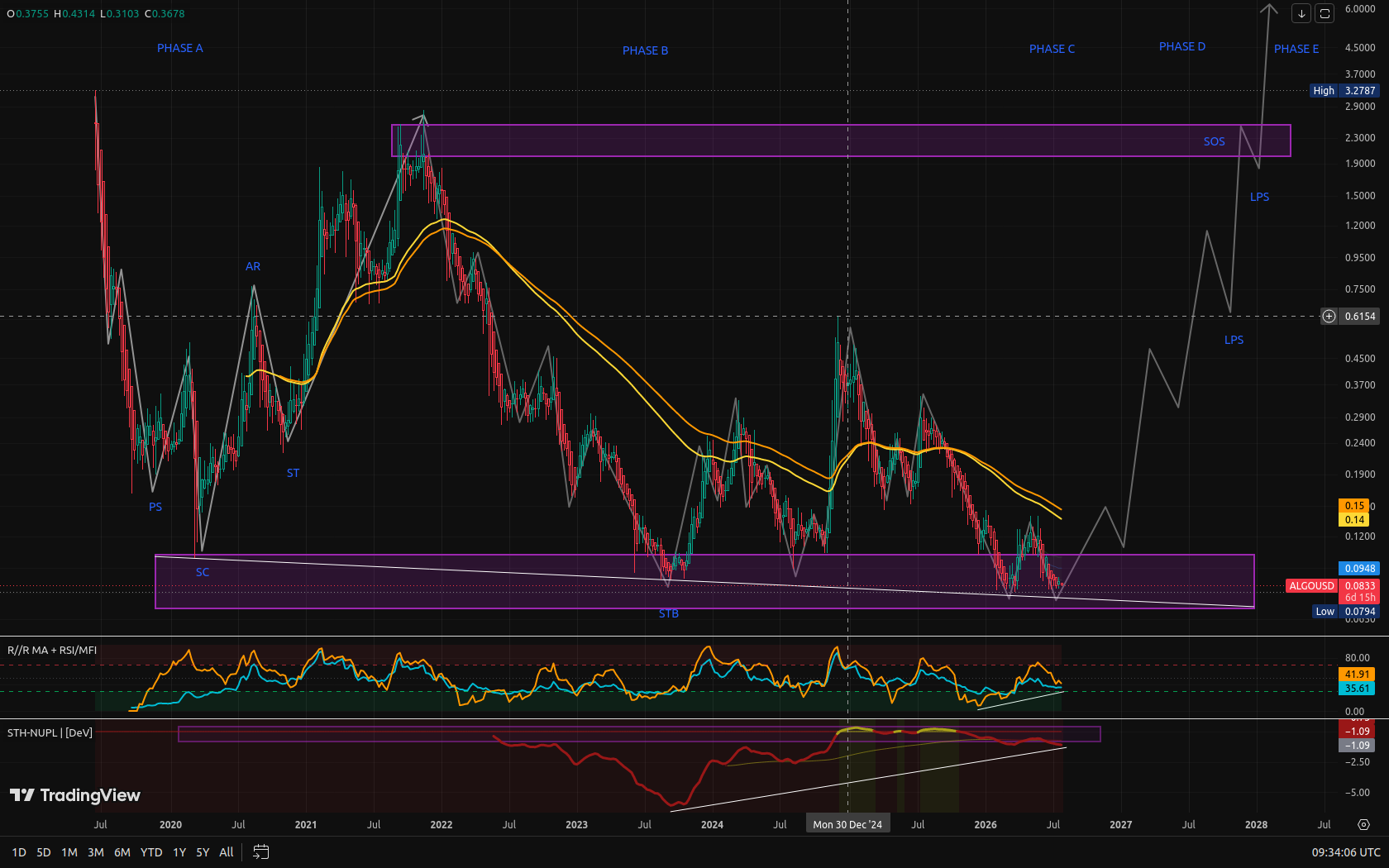
weekly structure · main hypothesis

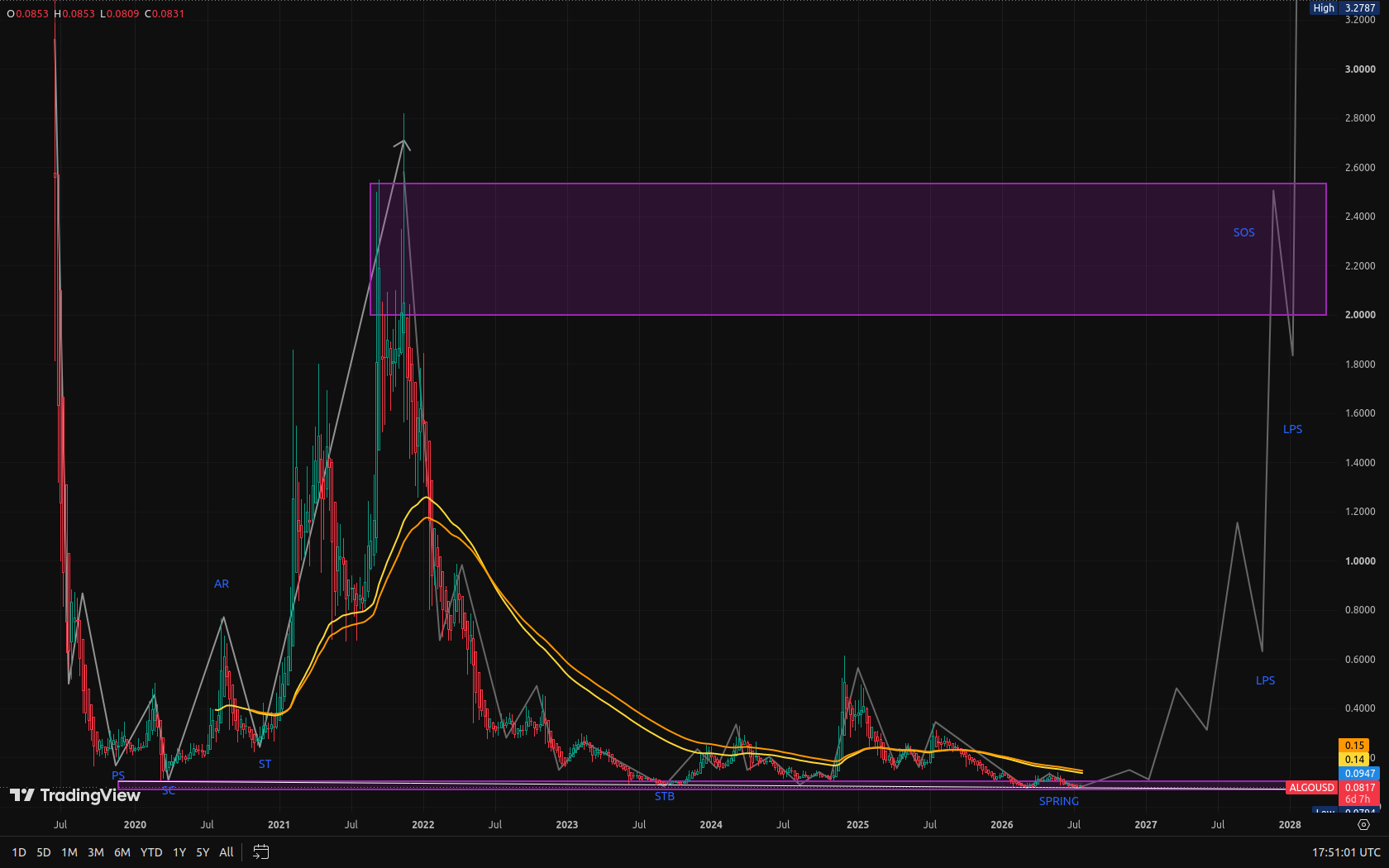
Possible Accumulation Pattern

Repeated contact with one broad floor can mean absorption, but it can also mean the floor is being consumed. The touch count is not enough. The evidence is whether selling produces less distance, whether price reclaims quickly, and whether the next departure is stronger than the previous rebounds.

ALGO weekly · possible accumulation maplogarithmic scale
Algorand weekly logarithmic chart showing the proposed accumulation structure
What the log view teaches: equal percentage moves receive equal visual space. That makes the proportional structure readable after a decline from several dollars to below ten cents. It does not prove accumulation; it prevents the early high from flattening everything that happened afterwards.
ALGO weekly · same historylinear scale
Algorand weekly chart on a non-logarithmic scale
What the linear view teaches: the present base is tiny in absolute dollar terms compared with the launch and 2021 peaks. Use it as a reality check. The log chart may reveal percentage compression; the linear chart shows how much price territory remains unrecovered.
ALGO spot · weeklyTradingView Advanced Chart
The widget starts on the weekly spot chart. Switching quotation currency helps expose exchange-specific gaps, liquidity differences and whether one venue is distorting the pattern.

Absorption case

more effort · less downside result

Repeated tests become constructive when selling creates less distance, weekly closes recover and rebounds begin travelling farther.

the departure confirms the floor—not the number of touches

Decay case

smaller rebounds · longer time below support

If each recovery weakens while ALGO/BTC falls, repeated contact can mean demand is being exhausted rather than supply absorbed.

support is an inventory of buyers and can be consumed

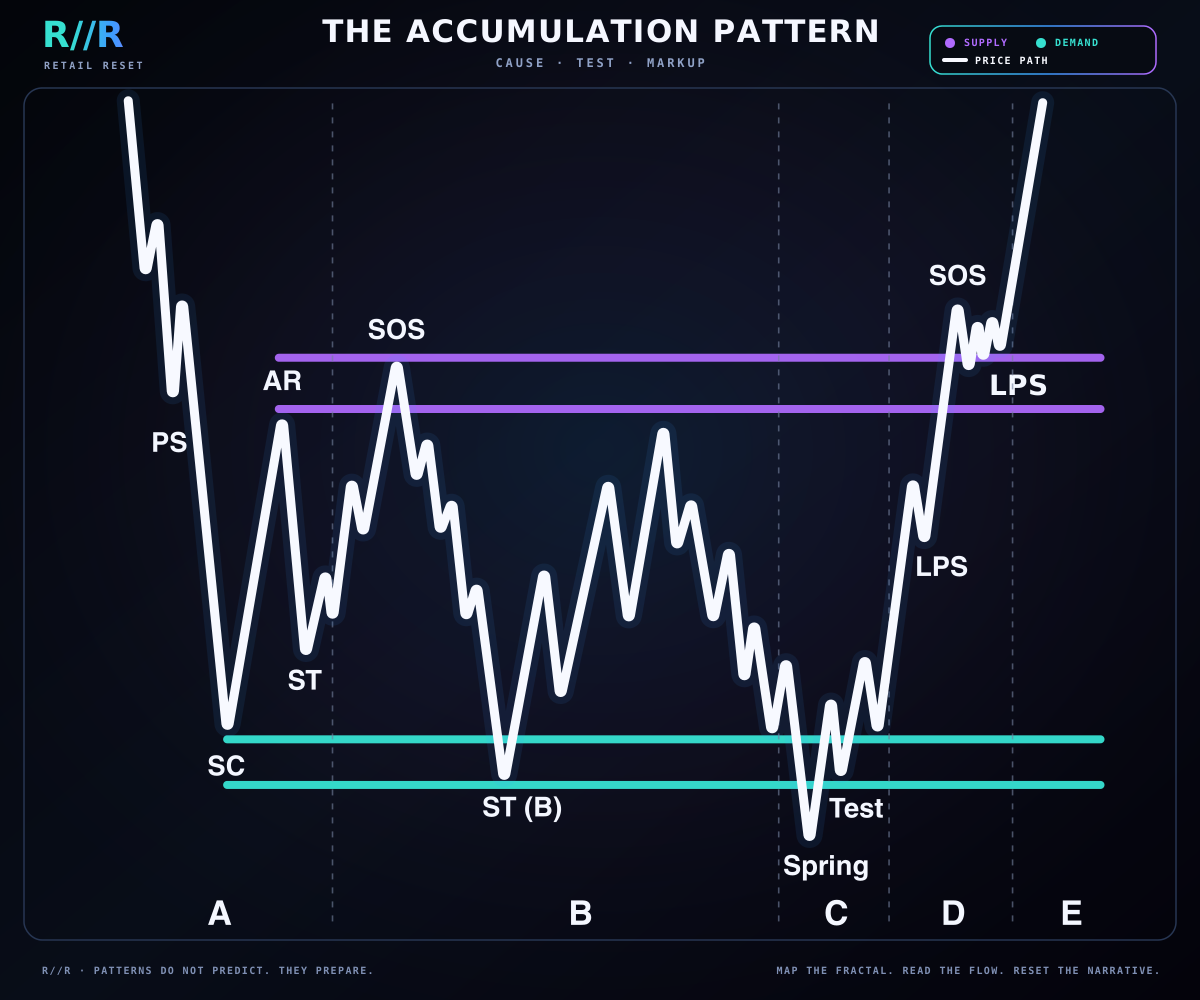
What unlocks Phase D

spring/test → SOS → LPS

A real Sign of Strength should escape the range. The Last Point of Support is the later pullback that holds above reclaimed structure.

do not place the LPS before price has produced the SOS
Wyckoff accumulation referenceR//R vector schematic
Retail Reset vector schematic of a Wyckoff accumulation pattern
Put the SVG at assets/img/patterns/wyckoff/rr-wyckoff-accumulation.svg. The horizontal supply lines now match each other in length, the demand lines match each other in length, and the former BU/LPS label is simplified to LPS.
launch mechanics · ownership history

The Seed, the Auction and the 2021 Escape Attempts

A crypto chart begins with a distribution mechanism. A low seed can discover value upward. A high-attention auction with limited float can begin above sustainable demand and discover value downward. Algorand’s public market history started in the second condition.

19 June 2019

The public auction

Algorand’s first public auction sold 25 million ALGO at $2.40 each, raising roughly $60 million. That opening price was formed from a small fraction of the eventual 10-billion-ALGO supply, so the exchange print should not be confused with a mature, broadly distributed fair value.

supply discovery

Float expanded into public demand

Early relay-node and backer allocations were distributed through vesting programmes. The Foundation’s own reporting describes heavy early inflation and later accelerated vesting. This gives a concrete supply explanation for part of the early collapse without requiring an unprovable claim that one hidden institution controlled every candle.

Launch patternWhat it meansWho becomes trappedHow the range is cleared
Low seed → upward discovery Public demand grows faster than available supply. Mostly late-cycle buyers near later peaks. Prior highs become support after ownership forms above them.
High seed → downward discovery Thin float and expectation create a price that wider circulation cannot support. Launch buyers and later buyers using the launch print as a fair-value anchor. Price must rebuild demand and absorb break-even selling on every revisit.
Unlock staircase Rallies repeatedly meet treasury, backer or reward inventory. Buyers who mistake temporary scarcity for permanent scarcity. Distribution slows, demand rises, and a higher value area survives a retest.
September and November 2021

ALGO nearly revisited the old valuation

The 2021 bull market returned ALGO towards the launch region, but it did not keep that territory. Heavy accelerated vesting also overlapped parts of 2021. That overlap is relevant supply context, but it does not prove every top was a coordinated insider dump.

the trapped-range rule

$3 is not cleared by touching it

The range becomes support only after price reaches it, absorbs holders seeking to exit, stays there long enough to build new ownership, and later retests it successfully. A wick to break-even merely gives some holders liquidity.

relative strength · cycle timing

Bitcoin Sets the Tide

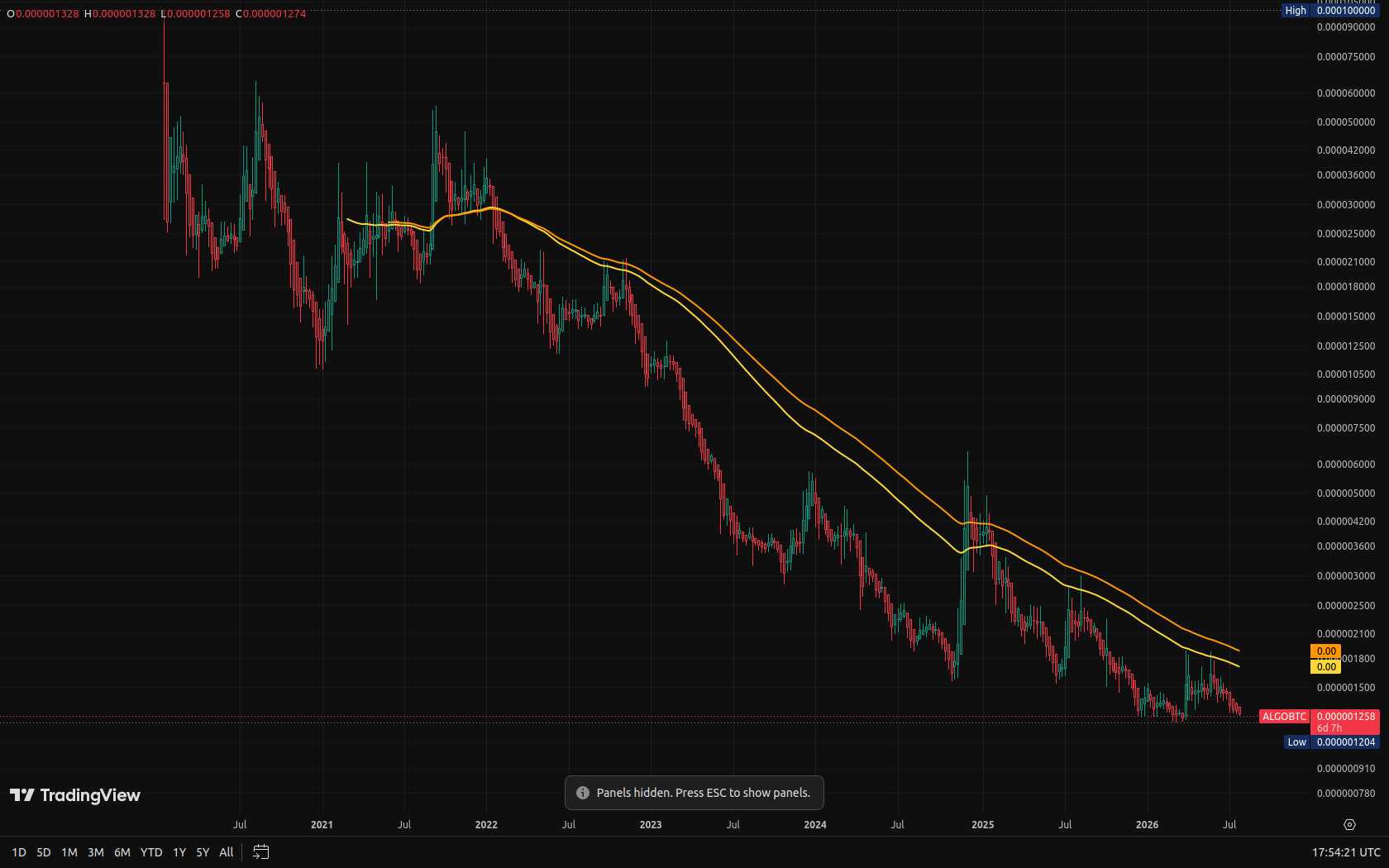
ALGO/USD measures dollars. ALGO/BTC measures opportunity cost. The September and November 2021 peaks are especially useful here: if the dollar chart rises while the BTC pair fails, the move is market beta rather than independent strength.

ALGO / BTC weeklyrelative survival
Algorand versus Bitcoin weekly chart
Mark the launch, March 2020, September 2021, November 2021, Bitcoin’s November 2022 bottom, ALGO’s later 2023 low and the present range. Bitcoin can bottom first while a weaker altcoin continues losing relative value.
ALGO / BTCTradingView weekly
The strongest rebuild would show the dollar chart, market-cap chart and ALGO/BTC chart turning together. A dollar-only rally remains dependent on Bitcoin liquidity.
capital structure · diluted history

Can the Old Ceiling Become the Next Floor?

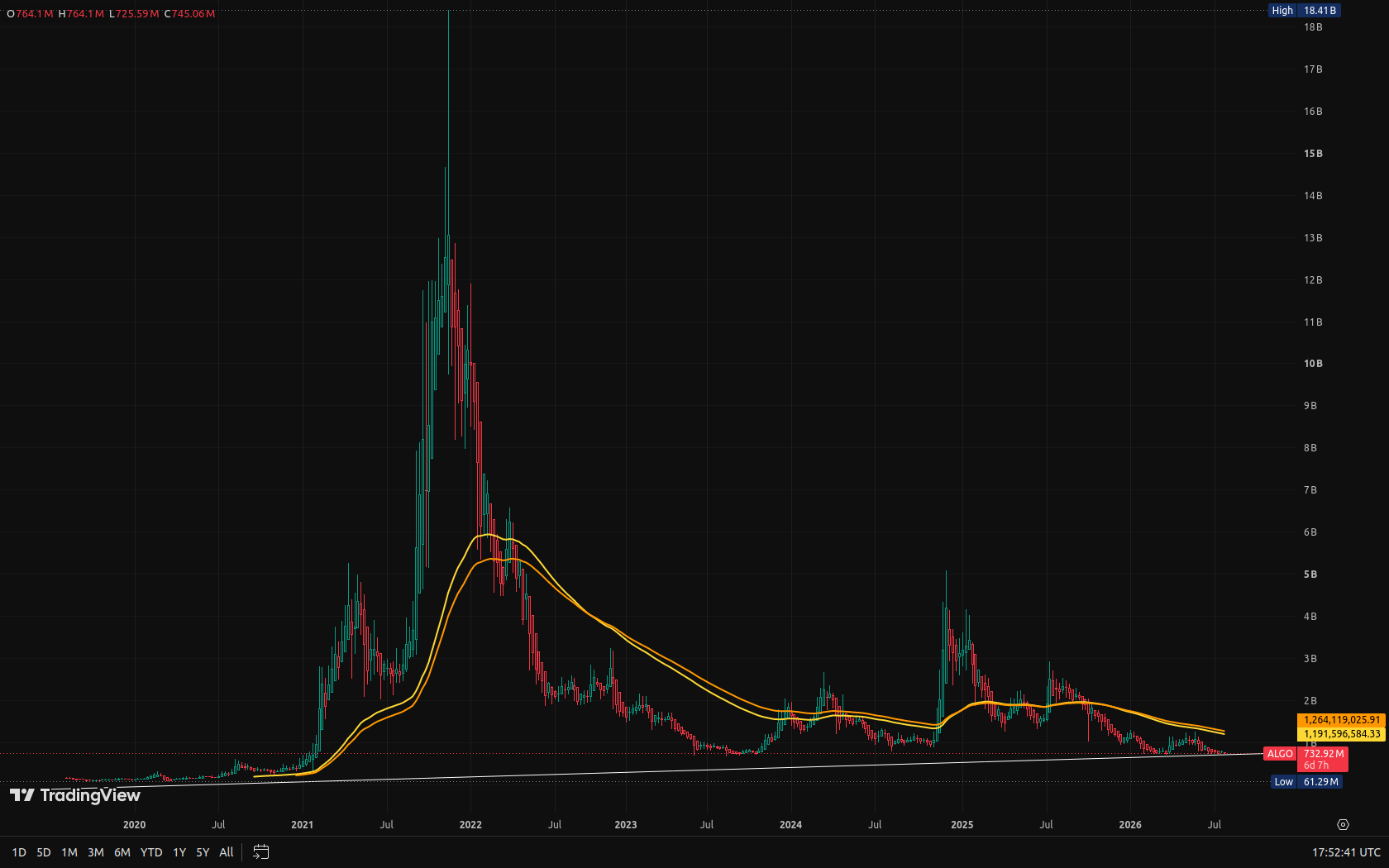
Unit price and market capitalisation answer different questions. Price shows what one ALGO costs. Market cap shows the total value assigned to circulating ALGO. Because circulation expanded over time, the market-cap chart can reveal capital retention that the unit-price chart hides—or confirm that both remain structurally weak.

ALGO market capitalisationannotated thesis
Algorand market capitalisation chart
The Ethereum resemblance is a hypothesis generator, not a forecast. Look for a higher capital floor, improved retention after sell-offs and a former market-cap ceiling that later survives as support.
CRYPTOCAP:ALGOTradingView weekly market cap
CRYPTOCAP:ALGO.Dshare of crypto market value
Dominance asks whether ALGO is capturing a larger share of the entire crypto market—not merely rising because everything else is rising.
market-cap equation

Price × circulating supply

With most ALGO already circulating, a future $3 price would imply a valuation near $27–$30 billion depending on circulation. The meaningful event would be defending that regime, not briefly printing it.

what support would mean

Old exit liquidity becomes new ownership

A successful cycle would absorb the 2021 supply zone, build volume and cost basis above it, then use the same area as support. That is how a ceiling becomes the foundation for later triangles and expansion.

cryptography · protocol rails

How Algorand Actually Works

Algorand is not merely “a fast blockchain.” Its design combines private cryptographic committee selection, Byzantine agreement, native assets and atomic settlement. Those choices determine what it can do—and which competitors it must beat.

RailWhat it doesWhy it mattersLimit
Pure Proof-of-Stake Stake-weighted cryptographic sortition privately selects block proposers and voting committees. Committee membership is difficult to target in advance and does not require proof-of-work mining. Security still depends on broad honest participation and stake distribution.
Byzantine agreement and finality Selected committees agree on one block without maintaining competing probabilistic forks. Once final, a payment or asset transfer does not wait through chain reorganisations. Finality does not itself create liquidity, users or token demand.
Algorand Standard Assets Tokens are issued natively rather than rebuilt entirely inside a smart contract. Issuers can use controls such as freeze, clawback and role separation for regulated assets. Issuer controls can add centralisation and counterparty risk.
Atomic transaction groups Several transfers either all succeed or all fail. Useful for delivery-versus-payment, swaps and multi-party settlement without one side being left incomplete. Application design and off-chain legal enforcement still matter.
AVM smart contracts Applications execute on the Algorand Virtual Machine using transaction and application logic. Supports DeFi, identity, tokenisation and programmable payment rules. Its developer and liquidity network remains much smaller than Ethereum or Solana.
State Proofs Falcon-signed certificates attest to compact snapshots of Algorand’s historical state. Designed for trust-minimised verification and protection of chain history against future quantum attacks. Ordinary account signatures are not yet universally post-quantum.
quantum reality

Meaningful progress, not complete immunity

State Proofs have used Falcon post-quantum signatures since 2022. Algorand demonstrated a Falcon-protected mainnet transaction in 2025 and targets broader quantum resilience by 2027. Current ordinary Ed25519-based accounts remain part of the migration problem, so “fully quantum-proof today” would be inaccurate.

competitive map

Who Algorand is really competing with

Ethereum and its L2s dominate programmable assets and liquidity; Solana competes on throughput and consumer activity; Avalanche competes for institutional subnets and tokenisation; Stellar and XRP target payments; Hedera targets enterprise-grade settlement. Algorand’s differentiator is the combination of instant finality, native asset controls, low fixed fees and a serious post-quantum roadmap.

NetworkRankMarket capvs ALGO
Live competitor dataCoinGecko unavailable
rails in production · actual users

Where Algorand Is Actually Being Used

A use case is stronger than a partnership announcement when value is issued, transferred or settled on-chain. These examples show the kinds of rails Algorand has found product-market fit for, without pretending it owns a dominant share of crypto.

humanitarian and consumer payments

HesabPay

HesabPay uses Algorand as payment infrastructure in Afghanistan. By July 2026, the programme reported support for more than 625,000 refugee returnees and 17,500 internally displaced people, with over $35 million in assistance. This is settlement infrastructure, not a speculative DeFi demo.

rail: reloadable payments, aid distribution, bill payment and traceability
tokenised travel inventory

TravelX

TravelX uses Algorand to represent airline tickets as transferable digital assets. The business case is operational: flexible resale and transfer rules, programmable refunds and new secondary-market revenue for airlines.

rail: high-volume native assets with consumer ownership rules
fractional property

Lofty

Lofty tokenises interests in US rental properties so investors can own fractions and receive rental distributions. The Foundation’s case study reported 148 tokenised properties across 11 states and an average of roughly 231 buyers per home.

rail: regulated ownership records, small-ticket access and distributions
tokenised treasury exposure

Midas mTBILL

Midas launched its regulated mTBILL product on Algorand in 2025. The first reported atomic swap exchanged $2 million of USDC for mTBILL in roughly two seconds at a network cost of 0.002 ALGO.

rail: atomic delivery-versus-payment for tokenised financial assets
Knowledge-transfer rule: network usage only helps the token when it creates recurring demand for ALGO, fees, stake, liquidity or collateral. A company can use Algorand successfully while holding very little speculative ALGO. The chain-use case and token-value case must be tested separately.
market share · live network pulse

What Share of the Market Does Algorand Actually Have?

“Market share” has no single denominator. Token market cap, DeFi liquidity, stablecoin balances, DEX activity and real-world settlement measure different competitive battles. The live cards below use CoinGecko and DeFiLlama where available.

crypto market share live unavailable ALGO market cap ÷ total crypto market cap
DeFi TVL $69M snapshot June 2026 official snapshot
stablecoins $49M snapshot 97% USDC in June 2026
DEX volume 24h live unavailable DeFiLlama chain overview
chain fees 24h live unavailable economic activity, not market cap
honest interpretation

Algorand is technically established but economically small

Its current token market cap, DeFi liquidity and stablecoin balance are far below the largest smart-contract networks. That makes the upside asymmetric if adoption expands, but it also means network effects and liquidity are not yet proven at dominant scale.

where the niche is stronger

Settlement efficiency and tokenised real-world value

Algorand’s best evidence is not raw TVL leadership. It is reliable settlement for payments, native controlled assets, humanitarian rails and tokenised financial products. The question is whether these niches compound into larger balances and recurring demand.

staking · wallets · real activity

What the Chain Actually Shows

This replaces vague “accumulation signals” with facts that Algorand actually publishes. The latest complete monthly snapshot available when this page was prepared was June 2026.

ALGO staked 2.02B+ about 22.6% of June circulating supply
community stake 80.6% Foundation share 19.4%
monthly active wallets 516K June 2026
monthly transactions ≈41M 3.64B cumulative
nodes 2,822 up 2.8% month-on-month
what staking proves

ALGO is participating in consensus

More than 2.02 billion ALGO was online in consensus in June. Community participants supplied most of that stake, which is useful evidence about decentralised security participation rather than merely passive wallet counts.

what staking does not prove

Staked ALGO is not locked supply

Algorand staking has no lock-up and no slashing. Independent validators retain control of their ALGO in their wallets. Therefore “2.02 billion staked” cannot be treated as 2.02 billion coins permanently removed from potential selling.

Algorand metricslive embedded dashboards
Exchange-flow limit: Algorand’s native ledger does not label “Binance,” “Coinbase” or “long-term holder” for you. Reliable exchange-inflow analysis needs address labels from tools such as ChainTrail, IntoTheBlock or CryptoQuant, followed by checks for internal wallet reorganisations. Do not turn every exchange withdrawal into an accumulation claim.
law · classification · consumer protection

Has the Law Deemed ALGO Safe?

No law declares a volatile token “safe.” Law can classify an asset, regulate firms, control how it is promoted and recognise property rights. Those are different from guaranteeing value or protecting buyers from loss.

United States · 2026

CFTC: ALGO is a digital commodity

A March 2026 joint SEC/CFTC release explicitly used Algorand as an example of a digital commodity, based on its characteristics, terms and functions at that time and its link to a functional crypto system.

United States · earlier cases

SEC complaints previously alleged securities transactions

Complaints involving Bittrex, Kraken and Cumberland included allegations concerning ALGO sales and promotion. Complaints are allegations, not a universal final judgment that every ALGO token or transaction is a security.

United Kingdom

Property and regulated promotion—not compensation protection

UK law recognises qualifying digital assets as property. Crypto promotions and service providers face an expanding FCA regime, with the broader framework applying from 25 October 2027. Ordinary crypto losses are generally not protected by the FSCS.

Correct page language: “ALGO has been identified by US regulators as a digital commodity under the 2026 framework, while earlier SEC enforcement complaints alleged that some offers or sales involved investment contracts. UK regulation governs promotion, custody and service providers; it does not certify ALGO as safe.”
signal versus hope

What Would Make the Accumulation Real?

The strongest case would combine chart structure, relative strength, market-cap expansion and genuine network participation. One attractive screenshot is not enough.

confirmation

Evidence that improves the thesis

  • Bedrock holds or briefly breaks and reclaims.
  • The next advance travels farther with less overlap.
  • Price reclaims the 59/72-week regime band and survives the retest.
  • ALGO/BTC stops making structural lows.
  • Market cap and dominance confirm instead of lagging.
  • Stake, users, stablecoin balances and real settlement grow together.
failure

Evidence that weakens the thesis

  • Weekly value establishes beneath the lower range.
  • Every rebound becomes smaller and shorter.
  • ALGO/BTC continues bleeding despite dollar rallies.
  • Market cap fails to retain a higher capital floor.
  • Network activity remains high but fees, liquidity and token demand stay negligible.
  • The next approach to $2–$3 becomes another exit event.
primary sources · data endpoints

Sources and Live Data

Live APIs can fail, rate-limit or change fields. The page keeps dated fallbacks and labels them clearly rather than turning old numbers into fake live data.